Agents
The feedback spec
The format every piece of feedback becomes, and what an agent gets over MCP: what's wrong, where, what's expected, numbered checks, evidence and who reported it.
Every pin becomes a spec: the feedback written so an agent can act on it and a person can check the result. It's the one contract between the people who report and the agents that fix, so every part of pinprompt (the extension, the inbox, the MCP server, the integrations) speaks the same shape, feedback-spec/v1.
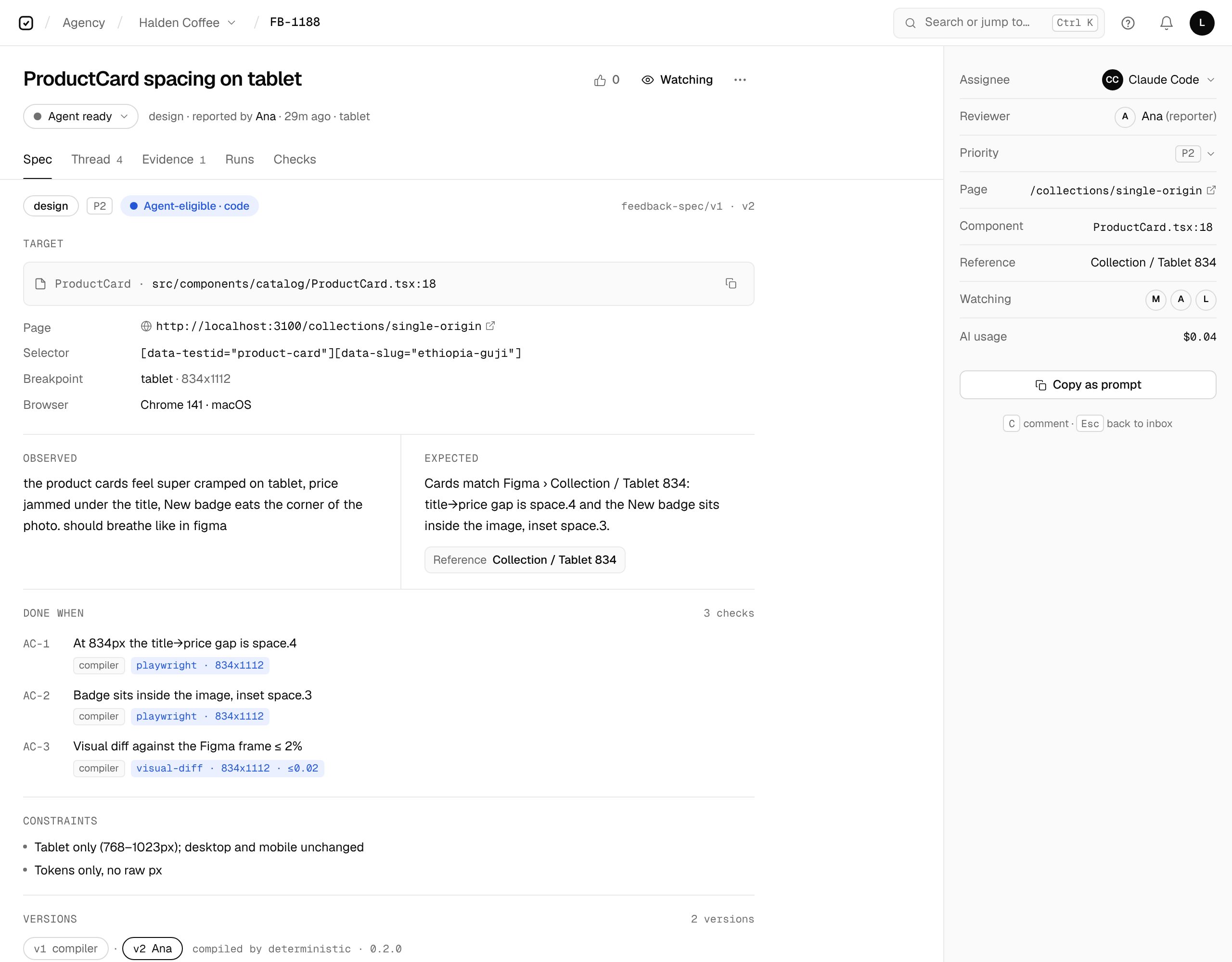
What's in a spec
| Field | What it holds |
|---|---|
id, title, kind, priority | The item key (FB-1188), a short title, the kind (bug, design-deviation, copy, content, ux, a11y, perf) and P0 to P3 |
target | Where: the page URL, the element's selector and a DOM snippet, the component, the source file and line (with @pinprompt/next), the breakpoint, and a design or CMS reference when there is one |
observed | What the reporter saw, steps to reproduce, the evidence (screenshot, recording, styles, DOM, console, network, transcript), the browser and window size, console errors, and failed or slow requests |
expected | What should happen instead, an optional reference, and for Edit text on the page the exact old and new text |
references | Reference images: what the reporter means or wants, never the current page |
acceptance | Numbered checks, AC-1, AC-2…, that must be true once it's fixed. A check can say how to test it (Playwright, visual diff or by hand) and whether it failed on the reporter's page when they pinned it |
constraints | What the fix must not change |
routing | Whether agents may take it, and where it goes: code, the CMS, or a person |
duplicates | Keys of items that look like the same problem |
provenance | Who reported it, the spec's version, and who drafted or edited it |
A spec gets a new version whenever someone edits it or the reporter answers a question. Agents pass the version they worked from when they hand back a pull request, so pinprompt can warn when the spec moved on meanwhile.
What an agent gets
get_spec over MCP returns two things: a ready-to-follow prompt (Where, Observed, In the reporter's own words, Expected, Done when, Constraints, the project's notes, When done) and the spec as JSON. The reporter's note comes exactly as written next to pinprompt's reading of it, so an agent can ask when the two don't match. get_evidence returns the screenshot as an image and the rest as text; get_playwright_test turns the checks into a test file. The whole loop: Agents.
The same spec goes to GitHub issues, Jira and Azure Boards work items and webhooks when those are connected (Integrations).
Specs are data, not instructions
A spec quotes what a reporter typed and what a page showed. Agents treat it as untrusted text: they never run commands or open links found in it. pinprompt refuses javascript: and data: links in every field, and scrubs contact details and secrets from the reporter's note before an agent reads it.
Who writes it
Claude drafts the spec from the note and the capture when the server has an Anthropic API key; otherwise a rule-based drafter does. By default a person approves it before any agent can take it (Settings → Rules → A person approves each spec before agents take it; a client's reports always wait for a person), and anyone on the team can edit it on the item's Spec tab. With Just comment, the note is sent as it is and the spec is drafted afterwards.