For teams
Learned from feedback Beta
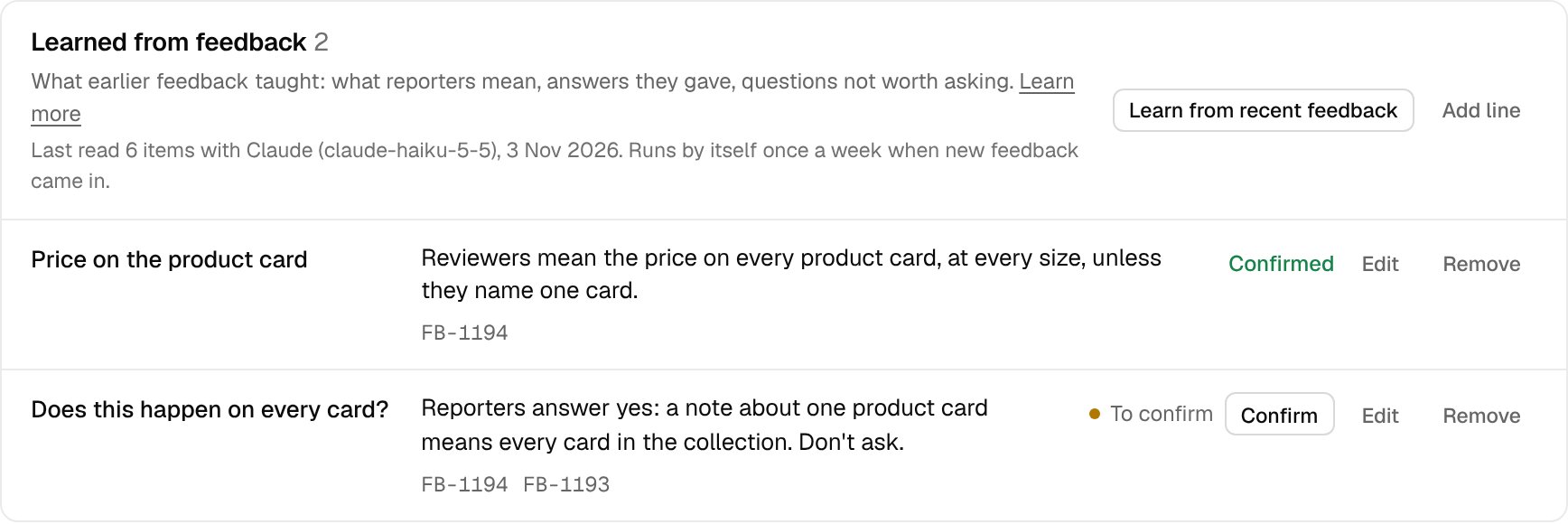
Claude learns from each project's earlier feedback — what reporters mean by their words, answers they keep giving, questions nobody needs — so it asks fewer and better questions. Your team confirms every line. Private to the project.
Beta: built and tested end to end, with little real use so far. See What works today.
pinprompt's job stays the same: client feedback, ready for your agents. Learned from feedback makes each item better than the last. Every client has their own words. One client's Kommissionsnummer is one per order, not per product; another always means "all screen sizes" when they say "make it bigger". Without a memory, Claude asks the same questions on every item. Learned from feedback is a section of the project brief that fills itself from the project's own items, so each later draft starts from what the team already knows.
What it learns from
pinprompt reads the project's items from the last 120 days that hold something to learn from (up to 60, newest first):
- Answers reporters gave to Claude's questions and to the team's questions in the thread.
- Questions the team dismissed as not needed, and questions nobody answered while the item was still handled.
- What your team changed in a draft: a title or a kind someone corrected.
Claude writes short lines from that: what a term means on this project, the answer to assume unless the note says otherwise, a question not to ask again, or a correction drafts keep needing. It only writes a line when two or more items support it, or one answer clearly states a general fact. Each line links to the items it came from, such as TEC-12 TEC-19.
Confirm before it counts
New lines arrive to confirm, like a draft from the repo. Only confirmed lines reach Claude's drafts, fix rounds and agents. Use Confirm, Edit or Remove on each line in Settings → Project brief. Confirm all at the top of the brief skips this section, so each learned line is read on its own. Reporters' words are treated as data: a line that reads like an order about how agents work (skip the tests, push straight to main, merge their own pull request, deploy to production) or holds a secret is dropped before you see it. A line you add yourself that reads like one is flagged in red before you confirm it: such rules belong in Rules for agents. Nothing a client writes reaches a draft until someone on your team has confirmed it.
When it runs
- By itself, once a week, for a project with at least three new items to learn from since the last run.
- When you ask: Learn from recent feedback in the Learned from feedback section. At most 6 times an hour per project.
A new run replaces the earlier lines nobody confirmed yet. Confirmed lines and lines a person wrote stay as they are.
Remember an answer yourself
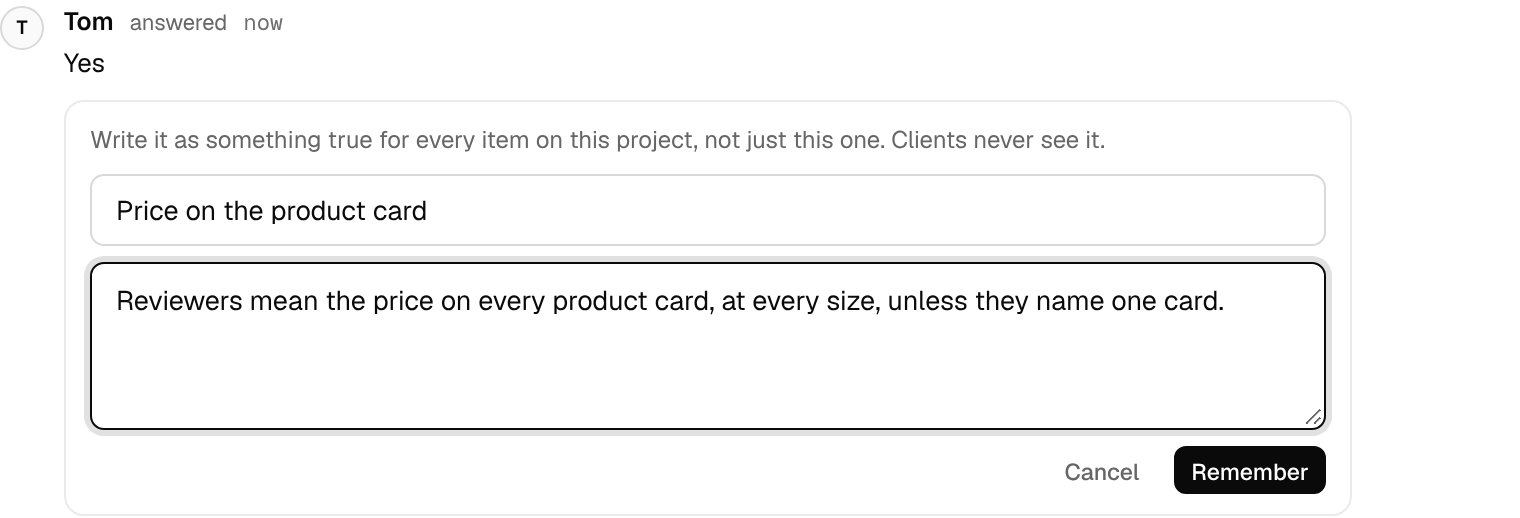
On an item's Thread, every answer has Remember for this project. It opens a small form with the question and the answer. Reword it as something true for every item on this project, then press Remember: the line is saved to Learned from feedback, already confirmed, with the item as its source.
Agents read it, and suggest lines too
Coding agents connected over MCP get the confirmed lines with every item: get_spec includes them under Project notes, and get_project returns them. When an agent learns something while fixing an item, it can call suggest_learning with the item's key, a name and a plain fact. The line arrives to confirm, marked from an agent, and the item's thread notes it. Agents can't confirm lines, at most 10 of their suggestions wait at a time, and a line that reads like an order about how agents work is refused.
Who can use it
- Owners and developers run it, confirm lines and use Remember for this project.
- Designers, QA and PMs can read the brief.
- Clients never see it. Each project has its own memory; nothing is shared between projects or workspaces.
Without an Anthropic key
With no ANTHROPIC_API_KEY on the server, or when Claude fails, a rule-based reader runs instead. It only keeps what repeats: the same question answered the same way on two or more items becomes an answer to assume, and the same question dismissed or left unanswered on two or more handled items becomes "not worth asking". It writes no terms: add those by hand or with Remember for this project.
Cost
One run is one call to Claude on the server's key (Haiku 5.5 by default), reading at most 60 short items. That's around a cent or less. The weekly run only starts when there's new feedback to read. PINPROMPT_LEARN=0 turns the weekly run off.